Reports & Research
For the First Time Since 2022, LGBTQ+ Representation on Fortune 500 Boards Declines
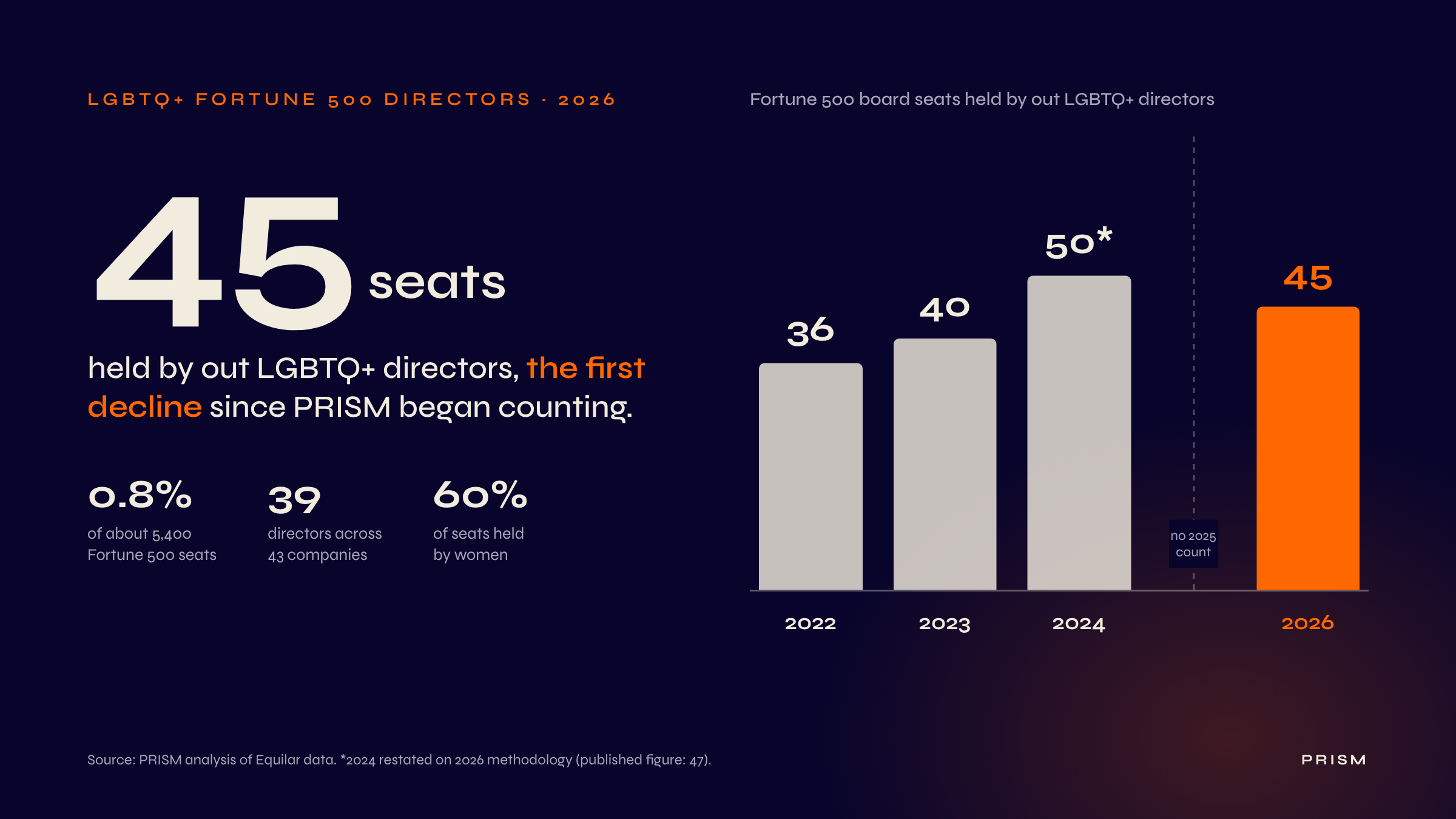
PRISM's 2026 count finds 45 Fortune 500 board seats held by out LGBTQ+ directors, down from 50 in 2024. It's the first decline since we began counting, driven by deals that took companies off the list and a pipeline that isn't adding new directors.
On September 30, our friends at 50/50 Women on Boards reported that women's share of Russell 3000 board seats fell to 29.2%, the first annual decline in more than a decade (Fortune). Ahead of its Annual Summit on October 26 in New York, PRISM, the Association of LGBTQ+ Corporate Directors, finds the same reversal on a different measure: for the first time since we began counting, the number of Fortune 500 board seats held by out LGBTQ+ directors has fallen (see the full 2026 list here).
Using data from our partner Equilar, PRISM found that out LGBTQ+ directors now hold 45 Fortune 500 board seats (or 0.8%), down from 50 in 2024. Our count had risen every year before that, from 36 in 2022 and 40 in 2023, partly because we got better at identifying out directors. Those 45 seats belong to 39 people across 43 companies. That is about 0.8% of the roughly 5,400 seats available, at a time when about 9% of American adults identify as LGBTQ+, according to Gallup. Fewer than one in ten of America's largest companies has a single openly LGBTQ+ director.
The count matters more than ever because almost no one else is keeping it. California's AB 979, which required boards to include directors from underrepresented communities, including LGBTQ+ people, was struck down in court. In December 2024, the Fifth Circuit Court of Appeals struck down Nasdaq's board diversity rules (WSJ), so companies no longer have to disclose how many LGBTQ+ directors they have. PRISM's Fortune 500 list, published every year since 2022 (see 2022, 2023 and 2024), is now one of the only ways left to track progress.
Eleven seats from 2024 are gone, and at least six disappeared along with their companies: Rite Aid was liquidated; Walgreens, Nordstrom, and SpartanNash were taken private; Foot Locker was bought by Dick's; and Discover was absorbed by Capital One. Most of these directors landed well. Nancy Schlichting moved from Walgreens to Baxter, and Jennifer Wong followed Discover into Capital One's boardroom. Darlene Nicosia, who was listed as LGBTQ+ in Foot Locker's 2023 proxy disclosure, joined Ball in September. Jacinto Hernandez, who was on our 2022 list at Altria, returned to the Fortune 500 at Devon Energy in May. But only one director is genuinely new since 2024: Robert Chavez, former CEO of Hermès of Paris in the U.S., who joined Macy's last year. Worryingly, the pipeline is moving the same experienced directors from board to board rather than bringing in new ones.
Above all, this is a story about queer women. Women hold 60% of LGBTQ+ Fortune 500 seats, double their 29.2% share of Russell 3000 seats overall. Lesbian and queer women have been one of the most reliable sources of board diversity in corporate America. But they also bore most of this year's losses, holding eight of the eleven seats that disappeared. This highlights a lesson about the long-tenure problem. Across the Russell 3000, men hold 88.9% of seats held for 15 years or more. On our list, women hold four of the seven. As those long-held seats open up, LGBTQ+ women are a ready pool of experienced candidates.
The group is diverse in other ways, and it is getting older. People of color hold 40% of the seats, the same share as in 2024: the departures of three Black and Latino directors were offset by the arrivals of Chavez and Hernandez. The average age per seat rose from 61 to 63, and average tenure from 7.2 to 8.5 years. Six people hold two seats each, so a small group still carries much of this representation. We still could not identify a single openly transgender or non-binary Fortune 500 director.
Where LGBTQ+ directors do sit, they increasingly lead. Eight of the 45 seats are leadership roles. Tim Cook became Apple's executive chair this September after 15 years as CEO, and he remains lead director at Nike. Barry Diller chairs Expedia, and Jim Fitterling is executive chair at Dow and lead director at 3M. Amy Lane (NextEra), Ruth Ann Marshall (Regions) and Lorrie Norrington (Colgate-Palmolive) all serve as lead directors. The 50/50 data shows that boards with a woman as chair or CEO are more likely to be gender-balanced. Leadership roles shape who gets nominated next, and that is where real progress will come from.
"For years, board diversity was one of the defining conversations in corporate governance. That conversation has gone quiet," said Fabrice Houdart, Founder and Executive Director of PRISM. "But the talent hasn't gone anywhere. What matters now is the network: qualified directors who know each other and recommend each other. That is exactly what PRISM exists to support."
Join us. These questions will be at the center of the 4th Annual PRISM: LGBTQ+ Corporate Directors' Summit on October 26 in New York, hosted at Grant Thornton. The Summit brings together about 150 corporate directors, CEOs, investors, governance leaders, board recruiters, and senior executives for a full day on the issues shaping today's boardrooms. This year's theme is "Sharper Perspective. Stronger Boards." Register here. If you're attending the NACD Summit, join us the evening of October 13 for the PRISM dinner at National Harbor (details). The full 2026 list is available here.
Methodology: We published 47 seats in 2024. That count missed four long-standing seats (Carolyn Bertozzi at Eli Lilly, Amy Lane at TJX, and Ruth Ann Marshall at Conagra and Regions) and included one company, Asana, that is not in the Fortune 500. Counted the same way as this year, 2024 stood at 50 seats held by 42 people. All year-on-year comparisons in this article use the restated figure.